
The BRICS summit offers Modi an excellent platform to reach out to world leaders and conduct diplomacy on the very ticklish issue of reform of the world governance structure, and to exchange notes with his peers on international, regional and bilateral issues on the margins of the meeting, says Rup Narayan Das.

From early indications, the Modi government's foreign policy seems to be pragmatic and reciprocal, says K G Suresh.

'Whether he will apologise or not is not a problem.' 'I want him to make an effort to create a new world, by learning from history.'

'The coming two months could unfold unpredictable results or unpredictable consequences or both at the same time,' says Rajaram Panda.

A day after total shutdown in Assam to protest against the CAB, fresh protests erupted in the state and neighbouring Tripura and other parts of the nation.

While China is bigger and feels mightier at the moment, Beijing's rulers would be well advised not to be tempted to provoke India, for that would only trigger a chain reaction around the world that would not serve anyone's interests, says Sanjaya Baru.

The high-speed train line in a region already well-connected by rail, road and airways may have to struggle to stay viable
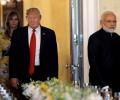
'China was the elephant in the Oval Office and Trump would have sensed that Modi's foreign policy architecture has become disoriented sans the US' pivot to Asia,' points out Ambassador M K Bhadrakumar.

Tarun Vijay on why the victory in Uttar Pradesh belongs to Narendra Modi and the road ahead.
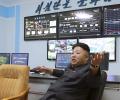
Will the unpredictable North Korean leader provoke conflict on the Korean peninsula?
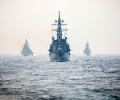
'Any future course of action towards active participation in the alliance when formed would need a lot of deliberation, long term vision and should be in our best national interests,' notes Commodore Vengalil Venugopal (retd).

'Modi and Obama both had agendas that went beyond the nuclear deal. The threat from the chilly Himalayas had to be tackled in the warm waters of the Indian Ocean.'

Obama's decision to visit India must be a result of his judgement that Modi is a man of action, feels Ambassador T P Sreenivasan.
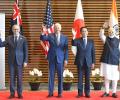
India has the ability in all respects to be a great power and address our security challenges in the best national interests, says Commodore Venugopal Menon (retd).

Pushback to Modi govt's policy pronouncements has already started, it now has a very small window of opportunity to bring in reforms.
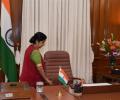
Sushma Swaraj, like Clinton, has a strong political base in her own party and is likely to have her imprint on foreign policy, says Ambassador T P Sreenivasan.
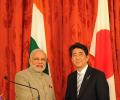
'Secretiveness and the element of surprise in announcing decisions marks the Modi style of diplomacy. From being a voluble politician, he became a reticent statesman... But the diplomatic dance is performed on thin ice and his adroitness is still to be proved,' says Ambassador T P Sreenivasan.

Silicon Valley can be replicated, but this will only be achieved so long as fresh talent is welcomed by both our countries - a move that will surely spark a billion ideas and discoveries.

When a Chinese warship entered Japanese waters, the Indian commander called on China to maintain discipline at sea. Dr Rajaram Panda explains the significance of the Malabar exercises between India, Japan and the US.
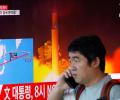
North Korea warns the US that it will soon 'suffer the greatest pain it ever experienced in its history'. Rajaram Panda looks at the latest twist in the North Korean crisis.

Trump is accompanied by First Lady Melania, daughter Ivanka, son-in-law Jared Kushner and the top brass of his administration.

'For years we train for the Olympics and when we are this close, how can we stop training?'
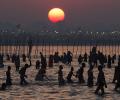
'Two have already sacrificed their lives.' 'How many more shall need to sacrifice before the government listens?' 'Four, five or six? They are ready, waiting.' After Ganga campaigner G D Agrawal's death, a Haridwar ashram's sadhus are on a relay fast unto death.

'... For the India-US relationship to continue its positive trajectory, it will require India to adapt to a different approach.' Nisha Desai Biswal -- who as the Obama administration's point person for South Asia was in the inner circle of all the Obama-Modi Summits -- tells Rediff.com's Monali Sarkar why she is hopeful that India and the US are on an irreversible forward course.
At no other time has a single meeting of the leaders of two democracies been so critical and hazardous.

'The lack of zeal to serve the country in the mammoth government machinery will be the biggest challenge for Narendra Modi and his government as he tries to change things; there will be not just resistance, but a lack of response to begin with.' If Narendra Modi becomes prime minister, Sheela Bhatt/Rediff.com says the issue of human resources, lack of talent and value system in governance will be his biggest challenge.

The world is still figuring out the man as he continues his enigmatic journey towards the first 100 days of his presidency.

'It is clear that Britain is a country with a limited future,' says Rajeev Srinivasan.

'As in the Panchatantra tale of the cat and the monkeys, it is possible for the clever swing State to play off the two competing powers.'

'It is my duty to give the govt the right price of crude oil.'

'India is a huge market for Chinese goods. I don't think a war stands to logic when you have economic compulsions, but then Chinese are known to do illogical things.'

'India should think big: About how in a multi-polar world, India can indeed be one of the poles, rather than being a secondary power that has to worry about 'alignment' with one of the poles. A G3 in other words, India should look to getting others to align with itself rather than the US or China,' says Rajeev Srinivasan.

'This is the first time that the Americans have agreed to refer to "cross-border terrorist attacks" in a joint statement.' 'No wonder Pakistan has called the joint statement "singularly unhelpful" and has blasted it, and its all-weather friend China has applauded Pakistan's frontline role in combating terrorism,' points out former foreign secretary Ambassador Kanwal Sibal.

'They don't have a political strategy so they are going to try to deal with it purely as a law and order problem.' 'They will try to use the same strategy they have repeatedly used since 2014 in Kashmir.' 'Mr Modi has landed in a situation where he faces the possible prospect of not only being unable to Indianise Kashmir, but his actions may end up making the rest of India a virtual carbon copy of Kashmir.'
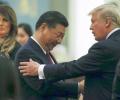
'While many Chinese policy makers dismiss the political, economic and technological component of US-India relations, they express caution on the defence-related ties which also happens to be a major driver in US-India relations,' explains China expert Srikanth Kondapalli.

'Like Nehru, too, Modi has found dealing with Beijing more and more difficult and has adopted an increasingly assertive approach towards managing India's northern neighbour.'

The Korean summit, laden with symbolism in everything from the choice of location to the mango mousse for dessert, could just be the first round in a continuing dialogue, says Dr Rajaram Panda.

'A plausible American tactic,' Rajeev Srinivasan suspects, 'would be to try and prevent the BJP and Modi from coming to power by splitting the anti-Congress vote using the AAP, and in case that fails, to follow up with a Plan B to make India ungovernable, to create mass conflict through their agents.'

'The Modi-Xi and Modi-Obama meetings, with an interval of just 12 days, are juxtaposed superbly at a crucial point in the prime minister's life. Can Modi carve out a win-win situation with the superpower and the emerging superpower at the same time?'

After Pyongyang tests a missile potentially capable of reaching the US, Dr Rajaram Panda explores the realistic -- and peaceful -- options before Donald Trump and the international community at large.
